 Syntra
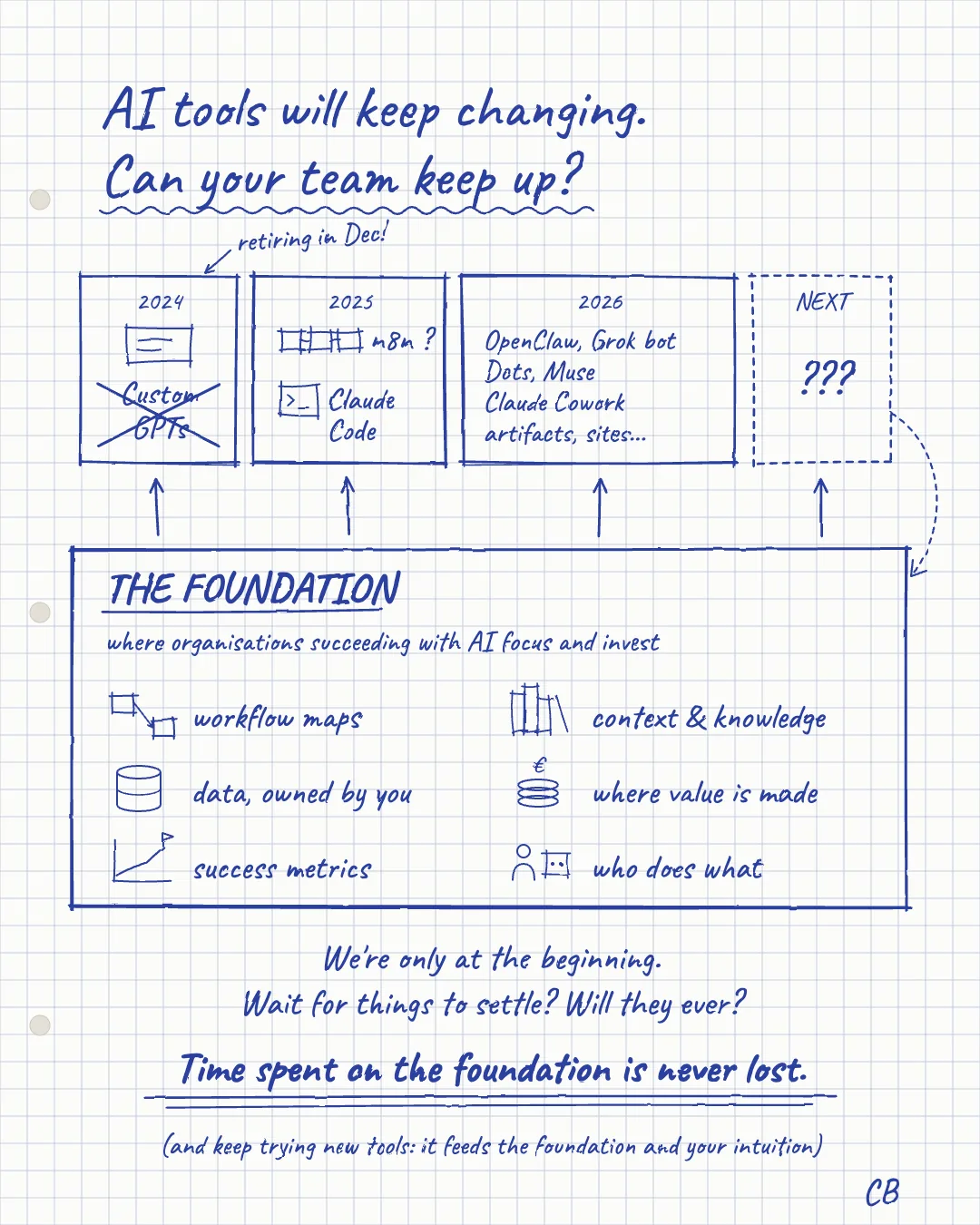
A year ago, I was running n8n workshops on a weekly basis. The year before, every conversation was about Custom GPTs. OpenAI retires those on 11 December and migrates them to plugins (a word that did not exist in this context twelve months ago). This year it was Claude Code, then Claude Cowork, OpenClaw, Grok bot, Dots, Muse. Agents everywhere.
Put the ecosystems side by side and they are shipping the same things: team workspaces, shared agents, admin controls. OpenAI, Anthropic, Microsoft, Google. The features converge. The names change.
Should we just wait?
It is the question I hear most from leadership teams, and it is a fair one. Nobody wants to be the person who trained 80 people on a tool that is retired the next quarter.
My answer: wait for what? We are only at the beginning. The tool layer will keep moving for years. If "settled" is the trigger, the trigger never fires.
The question hides a better one: what are we investing in that will still be worth something when the tool changes?
The foundation
The organisations I see getting real results do two things at once. They test new tools eagerly, because trying things builds intuition for what comes next. And they put their serious time into what sits underneath. Any tool can use it. No tool owns it.
- Workflow maps. How the work actually gets done, step by step, including the parts that live in people's heads. Who does what, person or AI. You cannot hand a task to an agent that nobody can describe.
- Context and knowledge, written down. Your rules, your exceptions, your definitions, your tone, kept outside the tool. Today it feeds a Custom GPT, in December a plugin, next year whatever comes next. The context is the asset. The model is rented.
- Data you own. Clean, defined, accessible, and not locked inside a vendor's workspace. If leaving the tool means losing the data, you do not own it.
- A clear view of where value is made. Where the margin is, where the hours go, where a mistake costs the most. That is where AI can grow value, and it is rarely where the demo was impressive.
- Success metrics, tracked over time. Per a16z's State of Markets II, 69% of the S&P 500 point to a live AI deployment, and only 2% disclose a metric they track over time. If you measure, you are already ahead of most.
We have been here before
I spent years in data and BI teams, at Adevinta and before. We fought the same battles: metric definitions, ownership, documentation. Everyone agreed it mattered. Few made the time.
Back then, a missing definition produced a wrong dashboard. Few people opened it, and the ones who did could spot the error.
Today the same missing definition produces a confident wrong answer in Slack, in front of everyone, in a few seconds.
Same debt. Paid immediately, and in public.
That is what AI really changes about the foundation. Not that it matters more. That the bill arrives faster.
Keep trying the tools
None of this means switching off the experiments. The opposite. Every new tool you try tells you something about where the work is going, and each trial costs less when the foundation is there: the context is already written, the workflow already mapped, the metric already exists.
Trying tools feeds the foundation. The foundation makes trying cheap.
We are only at the beginning. Wait for things to settle? Will they ever?
Time spent on the foundation is never lost.
If you want to know what your foundation looks like today, and where to start, book a call. Bring your workflows, we will skip the slides.