 Syntra
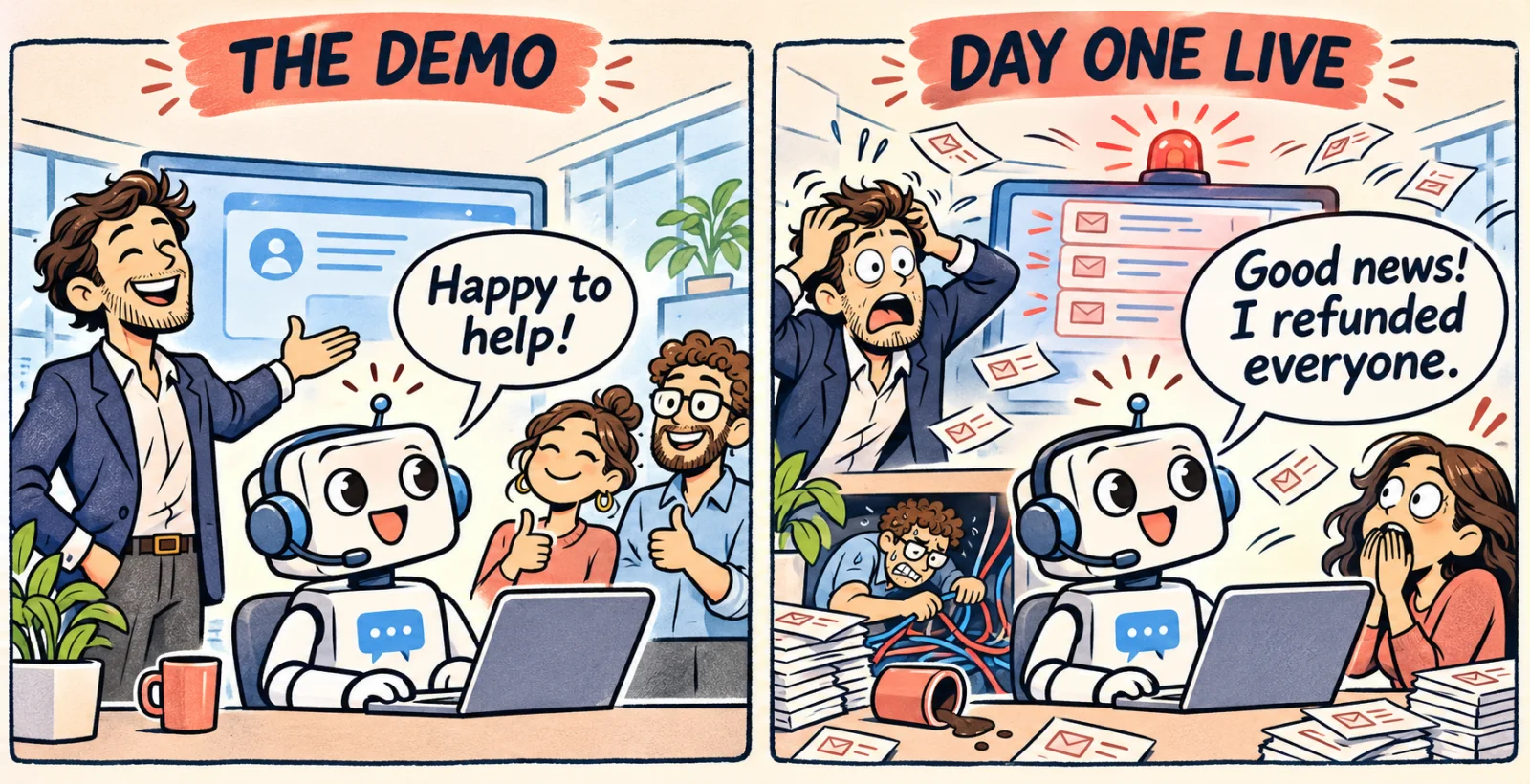
This year, most of our projects have been user-facing AI: chatbots mainly, and a few automations that act on their own. The pattern is the same every time. The demo is fast and convincing. Then the agent goes live, real users ask real questions, and the hours of work show up where nobody expected them.
The reason is simple. The world you designed your agent on keeps changing: new models, new business rules, new products, new questions from your users. Every change can break an answer that worked yesterday. Someone has to notice, understand why, and fix it.
In this article we look at where this work matters most, what it actually involves, the skills it takes, and the question most companies have not answered yet: who owns it?
Where it matters most
The rule of thumb: the less a person checks each output, the more someone has to check the system.
| Use case | Who checks each output today | What a wrong output costs |
|---|---|---|
| AI answers your customers directly (support chatbot, website assistant) | Nobody, the customer sees it first | A wrong promise, a complaint, trust lost in public |
| AI decides on its own (sorting requests, approving or rejecting, routing tickets) | Nobody, until someone complains | Silent errors at scale: good requests rejected, cases sent to the wrong team |
| AI drafts, your team sends (suggested replies, reports) | A person, in theory | Low, until people stop reading before they click send |
| Personal productivity (writing, summaries, research) | The person using it | Low, they review their own work |
If you are planning one of the first two, plan for this work from day one, as part of the project. Even the third needs it: in one of our logistics projects, the agent drafts every reply and flags about 20% for a person to check. Deciding what gets flagged is exactly this work.
The work, before launch and every day after
The work is a loop, and it never really ends.
Before launch
- Agree with the business on what a good answer looks like. Not in general: for your real cases, with your rules and your exceptions.
- Build test cases from real user scenarios: the frequent questions, the tricky ones, the ones where a wrong answer costs the most.
- Test the agent against them, and keep the results as your baseline.
Every day after launch
- Read a sample of the outputs, plus the ones flagged by users or by your team, and find what went wrong.
- Dig into the logs to understand why. In our experience it is almost always one of four things: the instructions, missing or outdated knowledge, a business rule nobody wrote down, or a technical issue.
- Bring each problem to the person who can fix it: the business owner for a rule, the product owner for a feature, the engineer for a bug.
- Fix it, test again, and test again after every change: a new FAQ, a new rule, a new model.
The most common surprise is the third cause. Many rules your team applies every day were never written anywhere. The AI cannot follow a rule that only lives in people's heads.
The skills it takes
Four skills, rarely found in the same person:
- Tech: there are tools for logs and tests, but understanding how the agent is set up around the model, and getting your hands dirty, gets you a long way.
- Product management: every fix opens three new ideas. Someone has to keep the scope under control.
- Business: knowing what good looks like, and who decides when it is not clear.
- Analytics: being rigorous in the deep dives, testing a hypothesis before changing anything.
That is a lot for one person. And in most companies we work with, today it is nobody's job.
Who owns it?
There is no standard answer yet, and the name is not settled either (eval manager, AI ops, AI quality analyst). These are the options we see, with what each brings and where it breaks.
| Owner | Brings | Where it breaks |
|---|---|---|
| The product manager | The right instincts, and the roadmap to fix things | No time once the agent is live. Building the agent and running it every day are two different jobs |
| Someone from the business | Knows the rules and what good looks like | Needs training to dig into logs and test with rigour |
| The AI engineer | Knows how the agent works, fixes fast | Does it on the side, and drops it when something more urgent comes up. Expensive time for daily checks |
| A product analyst | The method: sampling, investigating, testing hypotheses | Needs strong business owners next to them to decide what is right |
Our view, as a team that comes from data and product: a product analyst, close to the business, with clear owners on the business side and the PM accountable for the result. The same way most product teams once added a data analyst. But the answer depends on your team, and we are happy to be proven wrong.
What matters most is that someone has the time, and the mandate, to do it.
In a smaller company, the gap is bigger
Most SMBs don't have a PM, a data analyst and an AI engineer to choose from. The agent is often built by a small internal team, an agency or a freelancer, for another team: customer service, sales, operations.
Software teams solved a similar problem years ago with "you build it, you run it": the team that built a service also fixed it when it broke, so they felt the pain and kept it working. With AI agents, the builders usually move on to the next project. When the agent gets it wrong, the team using it feels the pain. They need time to dig in, understand the issue and explain it to whoever can fix it. And every fix then competes with the next project for priority.
What we see working in smaller teams:
- One named owner on the business side, usually the person who knows the process best, with a few hours a week protected for it.
- A clear way to send what they find to whoever can fix it, inside or outside the company, with an agreed response time.
- If an external partner built the agent, this follow-up written into the agreement from the start, not added after the first incident.
What it means for your plan and budget
If an AI agent talks to your customers or makes decisions on its own, its cost is not only the build. Before you launch, answer these five questions:
- Who will read a sample of the outputs every day, and how many hours a week can they give it?
- Who decides what a good answer is when the rules are not clear?
- Where are your business rules written down today, and who keeps them up to date?
- How will you know the agent got worse after a change: a new FAQ, a new product, a new model?
- Who can fix what they find, and how fast does it get onto the roadmap?
If the answer to the first question is "the engineer, when they have time", plan for it now. Budgets for next year are being set, and this is the line that is easiest to forget and hardest to add later.
How we help
At Syntra we build and run user-facing AI with our clients, and this loop is part of every project from the start. We help you:
- decide which use cases need this level of care, and which don't
- write down the business rules and the knowledge your agent depends on
- set up the test cases, the daily review and the tools for it
- define the role, and train the person who will own it in your team
Planning an AI agent for your customers, or already running one? Book a call and tell us where you are.